BY JP PAUL
www.proximitycouncil.com
AUGUST 1, 2026
If you have been watching the news this summer, you've likely seen the alerts.
In early July 2026, the PJM Interconnection, the wholesale electricity market serving 67 million people across 13 states and Washington, D.C., was pushed to the absolute brink. With a severe heatwave driving demand, PJM was forced to request emergency orders from the Department of Energy just to keep the lights on, explicitly authorizing the curtailment of massive data centers.
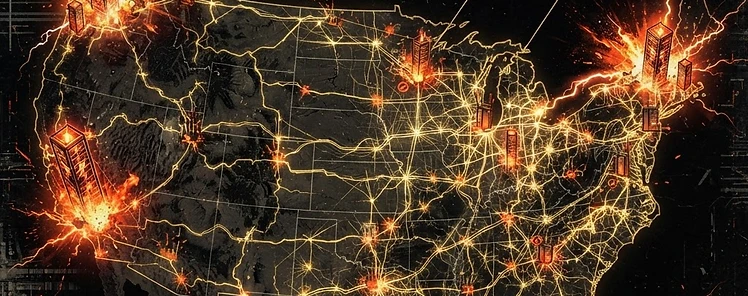
While the headlines focus on the weather and the macro-level energy crisis, the root cause is structural: The explosion of AI infrastructure is fundamentally breaking the U.S. power grid.
For a CEO running a $10M-$50M company, this is no longer just an infrastructure story. It is an immediate, bottom-line operational risk story.
The Math Problem: AI's Insatiable Appetite
The era of cheap, reliable, and abundant power is over, and the numbers are staggering.
According to recent Goldman Sachs forecasts, U.S. data center power demand is projected to more than double from 31 GW in 2025 to 66 GW by 2027. This isn't a slow build; it is a violent spike.
Traditional server racks consume roughly 5 to 15 kilowatts (kW) of power. Today's AI-optimized racks, packed with power-hungry GPUs training the models we now rely on, demand anywhere from 30 kW to over 100 kW per rack.
When you concentrate these hyperscale data centers in specific regions like Northern Virginia's "Data Center Alley," which sits squarely in the stressed PJM territory, you overwhelm the local grid's capacity to deliver. We are already seeing reports of wholesale electricity costs rising over 200% near these data center clusters.
Why This Matters for the Mid-Market
If you run a mid-market company, you aren't building a 50-megawatt data center. But you are absolutely in the blast radius of this energy crisis. Here is how this impacts your operations today:
Cloud Instability and "Digital Downtime"
The cloud is just someone else's computer plugged into a wall. If the regional grids powering major AWS, Azure, or Google Cloud availability zones face rolling blackouts or emergency curtailments, your SaaS tools, CRM, and digital infrastructure go down with them. You are now exposed to systemic outages that you cannot control.
Manufacturing and Logistics Disruption
If you run a local manufacturing facility, cold-storage warehouse, or heavy logistics operation in a stressed region like the Mid-Atlantic, the Midwest, or Texas, power instability translates directly to stopped production lines and spoiled inventory. Furthermore, as wholesale energy prices spike to meet this new demand, your baseline utility costs will skyrocket, compressing your margins.
Supply Chain Vulnerability
Even if your headquarters is located in a stable energy market, your critical suppliers might not be. A rolling blackout in a supplier's region can delay raw materials, completely disrupting your own fulfillment cycle.
Moving to Operational Resilience
In 2026, assuming the power will always be on is a strategic vulnerability. Mid-market leaders must move from reactive frustration to proactive resilience.
Here is what you need to be doing right now:
Audit Your Cloud Geography
Don't just ask if your data is backed up; ask where it is backed up. Ensure your critical cloud infrastructure and backups are distributed across different energy grids, not just different servers in the same vulnerable region (like Northern Virginia).
Invest in Hardened Infrastructure
For physical operations, backup generation is no longer optional. Whether it is industrial-scale diesel generators, solar-plus-storage microgrids, or uninterruptible power supplies (UPS) for critical local servers, you need the ability to operate autonomously for 24 to 48 hours.
Map Supplier Energy Risk
Treat grid instability as a core metric when evaluating vendors. Do you have a secondary supplier located in a different power market? If your primary manufacturer in Ohio loses power for three days, how quickly can you pivot?
The Bottom Line
The AI boom is driving incredible software innovation, but it is doing so at the expense of our physical infrastructure. The companies that survive the coming years of grid instability won't be the ones with the best AI prompts; they will be the ones that planned for the power to go out.
[READY TO ENGINEER YOUR RESILIENCE?]
The Proximity Council gives you the frameworks, accountability, and peer-level perspective to build operational systems that survive the infrastructure crises of 2026.
EXPLORE THE PROXIMITY JOURNEY