BY JP PAUL
www.proximitycouncil.com
AUGUST 6, 2026
For a long time, geopolitics felt like something that only Fortune 500 CEOs and cable news anchors needed to worry about. If you were running a $15 million manufacturing or e-commerce business in the Midwest, your primary supply chain concerns were unit costs, lead times, and vendor reliability.
In 2026, that luxury is gone.
Geopolitics is no longer background noise. It is a line item on your P&L, and it is actively shrinking your margins.
Between the ongoing instability in the Middle East, the continued threat of tariffs and trade wars, and the resulting chaos in global shipping lanes, the era of the perfectly optimized, single-source global supply chain is over.
For mid-market operators, this isn't just an inconvenience. It is an existential threat to your operating cash flow.
The Middle East, Chokepoints, and "Disruption Premiums"
If you want to understand the new reality of global trade, look at the world's maritime chokepoints.
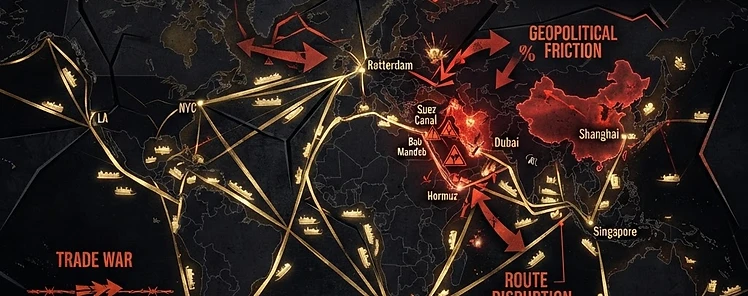
Throughout early 2026, escalating tensions in the Middle East have forced major carriers to avoid the Red Sea and the Suez Canal, rerouting massive cargo ships around the Cape of Good Hope. Simultaneously, threats in the Persian Gulf have led to suspended transits in the Strait of Hormuz.
The result? According to recent maritime intelligence, these diversions have pushed shipping costs up by more than 20% on key global routes. We are seeing the return of emergency surcharges (ranging from $1,800 to $3,800 per container) and skyrocketing war-risk insurance premiums.
When a massive enterprise like Coca-Cola faces these issues, they have the capital reserves to absorb the "disruption premium" or the leverage to renegotiate terms on a massive scale.
If you are a $20M business relying on imported raw materials or components, you don't have that leverage. You absorb the cost directly into your margin, or you pass it to your customer and risk losing market share.
The Tariff Whiplash and the Death of "Just-in-Time"
Compounding the physical shipping risks is the ever-changing landscape of international tariffs. The U.S. manufacturing sector is currently navigating a highly volatile tariff environment, driven more by executive action and political posturing than stable, long-term policy.
This uncertainty is creating what industry analysts are calling "demand whiplash."
When tariffs threaten to increase the cost of imported goods by 5% to 10% overnight, businesses panic-buy inventory. This strains capital reserves (pulling the "Inventory/WIP Lever" in the wrong direction) and clogs local warehousing.
The old "Just-in-Time" (JIT) inventory model was built on the assumption of global stability. In 2026, JIT is dead. The new mandate is "Just-in-Case," but holding that much safety stock is financially crippling for a mid-market company.
Moving from Reactive to Resilient: The Nearshoring Imperative
If relying on Asia-to-US shipping routes and crossing your fingers against tariff hikes is no longer a viable strategy, what is the play for the mid-market?
The answer is structural resilience, and it is manifesting primarily through Nearshoring and Regionalization.
What was once a long-term strategic conversation has become a near-term operational necessity. Recent research shows a massive shift in executive mindset: top leaders now rank increased cost pressures from geopolitics as their number one short-term challenge. In response, a significant percentage of U.S. businesses are actively scaling back operations heavily reliant on distant international supply chains.
Here is what smart mid-market operators are doing right now to build resilience:
The Chokepoint Audit
You cannot fix what you cannot see. Do you know exactly where your Tier-2 and Tier-3 suppliers are located? Map your supply chain end-to-end and quantify your exposure to high-risk corridors. If 40% of your critical components pass through a single contested strait, you have a structural vulnerability.
Dual-Sourcing with a Regional Bias
It is time to accept slightly higher unit costs in exchange for guaranteed delivery. If your primary supplier is in Asia, you must develop a secondary, active relationship with a supplier in Mexico, Latin America, or domestically within the U.S.
Valuing Resilience Over Efficiency
When evaluating your operations, stop optimizing purely for the lowest possible cost per unit. Start optimizing for the lowest possible risk of disruption. An agile, regionalized supply chain might look slightly less profitable on a spreadsheet during a perfect month, but it will save your business during a global crisis.
The Bottom Line
The global supply chain is not going back to "normal." The volatility we are seeing in 2026 is the new baseline. The mid-market companies that thrive in the coming decade will be the ones that recognize geopolitics as a core operational variable and actively redesign their supply chains for resilience, agility, and regional control.
[READY TO BUILD A RESILIENT SUPPLY CHAIN?]
The Proximity Council gives you the frameworks, accountability, and peer-level perspective to build supply chains that survive geopolitical volatility.
EXPLORE THE PROXIMITY JOURNEY