BY JP PAUL
www.proximitycouncil.com
AUGUST 1, 2026
If you walk into a board meeting today and proudly announce a new "Generative AI pilot," you are already two years behind your competition.
In 2024 and 2025, the business world was obsessed with Generative AI. We bought subscriptions. We ran isolated pilots. We gave everyone a "Copilot" to help them write emails and summarize meetings.
But as recent data from PwC and other leading analysts confirms, enterprise strategy has fundamentally shifted. The era of the isolated AI pilot is dead.
Smart CEOs realized that a text generator, no matter how intelligent, is essentially a brain in a jar. It can think, but it has no hands. It still requires a human bottleneck to prompt it, copy the data, make the final decision, and click "execute."
To actually drive margin expansion in 2026, companies are moving beyond Generative AI and aggressively deploying Agentic AI. But even that isn't the final destination. The true operational leverage lies in the next frontier: AI Orchestration.
The Evolution: From Generators to Agents to Teams
To understand where we are, you have to understand the three phases of this technological shift:
Phase 1: Generative AI (The Assistant)
You ask a tool to write a vendor dispute email. It writes it. You copy, paste, and send it.
Phase 2: Agentic AI (The Employee)
You give an AI agent a goal: "Resolve this vendor dispute." The agent reads the email, checks the SLA in your contract database, drafts the response, and sends it automatically based on predefined rules.
Phase 3: AI Orchestration (The Digital Workforce)
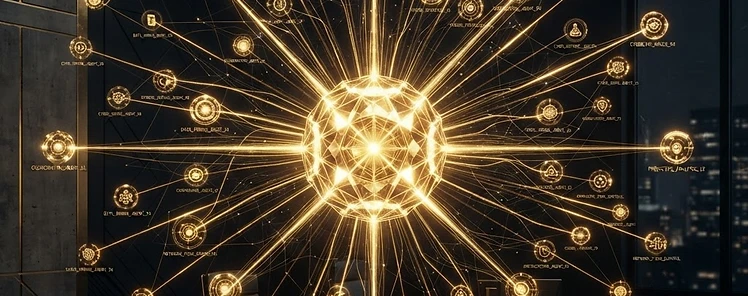
You aren't just deploying a single agent to do a single task. You are deploying an "Orchestrator" that manages a team of specialized agents to execute complex, multi-departmental workflows.
The SAP Standard: Managing AI Like a Human Team
If you want to see where the mid-market is heading, look at what the enterprise giants are building.
SAP recently introduced tools like Joule Work, which perfectly illustrates this paradigm shift. It allows business leaders to manage teams of AI agents across core business functions as if they were managing human departments.
Imagine a massive supply chain disruption. In the past, this meant emergency meetings between Procurement, Finance, and Logistics.
Under an orchestrated AI model:
The Orchestrator Detects the Disruption
An incoming alert signals the supply chain disruption. The Orchestrator immediately begins coordinating the response across departments.
The Procurement Agent Finds Alternatives
The Orchestrator tasks the Procurement Agent to find alternative suppliers with available inventory, returning a shortlist of viable options.
The Finance Agent Calculates Margin Impact
The Orchestrator tasks the Finance Agent to calculate the margin impact of expedited shipping from the new supplier, ensuring the numbers work.
The Logistics Agent Reroutes Deliveries
The Orchestrator tasks the Logistics Agent to reroute the delivery schedules based on the new supplier and timeline.
A Single, Fully Baked Execution Plan
The Orchestrator compiles these findings and presents a single, fully baked execution plan to the human executive for final approval.
You are no longer asking AI to perform a task. You are asking AI to manage a project.
How to Pivot to Orchestration
If you are running a $10M-$50M business, you might not be buying massive enterprise SAP packages, but you must adopt the orchestration mindset. Here is how you do it:
Kill the "Isolated Pilot"
Stop allowing your marketing team to buy an AI tool for writing, while your finance team buys a separate AI tool for reconciliation. Isolated tools create siloed data. You need a unified platform where agents can communicate with each other across your CRM, ERP, and communication channels.
Map the "Handoffs"
Agents are great at specific tasks, but business value is lost in the handoffs between tasks. Map out your most complex workflows (e.g., from a signed contract to client onboarding to first invoice). Where does the data have to move from one department's software to another? That handoff is where you place your Orchestrator.
Redefine Human Management
When you deploy orchestrated agents, your human employees are no longer operators; they are editors and managers. You must train your mid-level managers on how to oversee digital workers. They need to learn how to monitor agent logs, tweak logic rules, and step in for high-level edge cases that the AI escalates to them.
The Bottom Line
Generative AI made us faster at typing. Agentic AI makes us faster at doing. But AI Orchestration is what will actually allow a 50-person company to operate with the output and sophistication of a 500-person enterprise.
Stop looking for the next cool AI feature. Start building your digital org chart.
[READY TO ENGINEER YOUR SYSTEMS?]
The Proximity Council gives you the frameworks, accountability, and peer-level perspective to build operational systems that scale beyond you.
EXPLORE THE PROXIMITY JOURNEY[CONTINUE THE DEEP-DIVE // INNOVATION, OPTIMIZATION AND AI]